Here is the sixth installment of recollections from D. Bruce Lockerbie.
My wife Lory and I have just celebrated the 50th anniversary reunion with the Class of 1966 during Alumni Weekend at The Stony Brook School. Our presence at these celebrations began with our first class in Hegeman Hall—the resoundingly memorable Class of 1958, when they gathered in 2008. Only 40 strong, they were remarkable for their academic achievement, receiving acceptances at all eight of the Ivy League universities; for their athletic prowess, with Allan Malachuk winning Newsday’s Long Island Athlete of the Year award over an East Ender named Carl Yastrzemski; for their loyalty to each other, and their patience as old hands at this business of communal living, yet with a rank rookie in charge of their lives.
This is the class that endured my novice year as a boarding school “master,” as we were known. Master of what? I barely knew how to tie my own shoes. I had just turned 22 years old, husband of a young bride, expecting our first child in a few weeks. I was too stretched and stressed by multiple duties and obligations to be master of anything. Check this list of responsibilities, utterly common in those days: Teaching two sections of 9th and three of 10th grade English, overseeing the “sick, lame, and lazy,” as we insultingly referred to the non-combatants in afternoon exercise called “Class Athletics”; coaching the debate team and taking its members to compete; reviving and supervising the publishing of a long-neglected student newspaper The Blue and White (the pre-Christmas recess issue escaped with a missed typo reading “Merry Christmas and a Happy New York!”); during basketball season, rehearsing and leading a pep band; every week rehearsing and conducting “The King’s Men” for Sunday’s anthem and frequent Sunday evening concerts at churches throughout Long Island and the metropolitan New York City area. Add on dorm supervision one weeknight and every other weekend you get the picture.
Oh, yes, I was also maintaining a busy training and competitive schedule, representing the New York Athletic Club in cross country (we won the National AAU championship race in Chicago) and both indoor and outdoor track seasons at meets throughout the nation.
I had four colleagues like me, newly appointed to the faculty—three of them also recently married, one a bachelor—none of whom chose to remain in the boarding school fishbowl more than three years. We look back and wonder in amazement that God gave us the calling and the gumption to endure for 34 years.
The fall of 1957 was made especially difficult because of a nationwide plague-like flu that swept through the campus, afflicting boys and men (and our families) alike. As I recall, Lory was drafted to work as many days as she could (in spite of “being great with child,” as St. Luke describes Mary en route to Bethlehem) helping the School nurse and visiting doctor at the Health Center, making rounds as if in a hospital through the dorms where the sick remained in their rooms. Some sports events had to be cancelled because of the epidemic. The entire Stony Brook debate squad fell ill during an afternoon match at St. Paul’s School in Garden City.
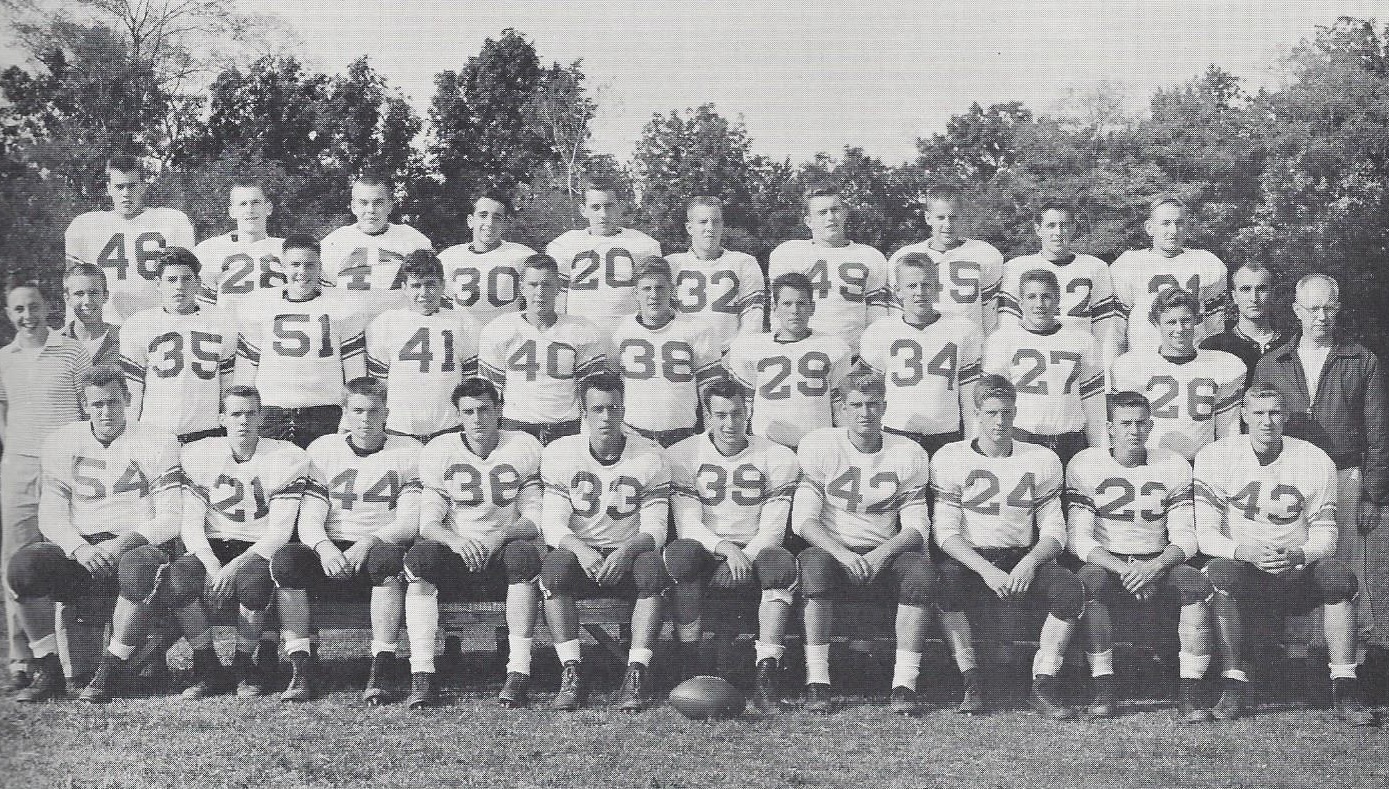
Still, I remember Floyd Johnson’s football team—with Malachuk as quarterback, David Skillen and Dick Skripak as running backs, Al McKegg, Hubert (now Bill) Cook, Bob Williams, and a couple of new guys named John Holbrook from New Jersey and Tom Gillan from Texas—were successful in beating Poly Prep 19-13, ending Poly’s seven-year domination of The Brook.
Marvin Goldberg had a young but winning cross country team comprised of only one senior Wain Barnes; the rest were led by Tonnie Coane (who went on to run on a world-record setting relay team at Kansas), Ray Searby, Lee Reineke, Herb Geiss, and that long-legged Ralph (“Call me Robin”) Lingle, about whom more in a later post.
“Back in the day,” boarding schools held classes on Saturday mornings. On Saturday, October 19, Lory awakened me early with the message we’d been waiting for: Her time had come, and we headed to Mather Memorial Hospital in Port Jefferson for the delivery of Donald Bruce Lockerbie, Jr., Class of 1975. After viewing my namesake son through the nursery window and rejoicing with his glowing mother, I headed to my classes in Room 13. Of course, I’d informed MWG that I might be delayed in arriving, and the word had quickly spread throughout the School. So I wasn’t surprised when, midway through a lesson, Frank E. Gaebelein appeared at the classroom door. I stepped outside as he greeted me with a broad smile as he clomped me on the shoulder: “So, you have a son!” Then came the other purpose of his greeting: “Many couples have brought a newborn into the dormitory and not found it necessary to alter the life of the boys.” In other words, no message posted on a bulletin board or resident’s apartment door: “SHHHH, BABY NAPPING!”
For FEG, it was always all about the students, “the boys.” I saw that vividly displayed one evening immediately after returning to our Hegeman Hall apartment after dinner. An urgent pounding on the door summoned me from whatever paternal duties I may have been offering to mother-and-son. There stood _______ (he knows who he is!) with dramatic concern all over his face: “Mr. Lockerbie, Smith and Jones (they know their real names also) are upstairs killing each other!” I knew exactly which room those two occupied, opposite the main staircase on the second floor. Taking the informer at his word, I sprinted past him and up the stairs in my best NYAC stride, then burst into the room, mouth first. Of course, I expected to see a teenage duel of honor in progress. Instead, there sat the saintly Headmaster, bowed deeply in prayer with his arm around the shoulder of a troubled Sixth Form student who (I subsequently learned) had intended to run off from school. So intense was Dr. Gaebelein’s intercession, he never heard my interruption. I backed out of the room, just in time to see my grinning tormentor halfway down the corridor, congratulating himself on having gulled the naïve master. He and I have since had occasion to laugh together. But I never told FEG the story.
So that year progressed. Malachuk, Skillen, Skripak, and Toby Walker were the core of Coach Jim Fenton’s basketball team. McKegg and Les Sogorka led Coach Don Marshall’s wrestlers. As spring arrived, Pierson Curtis coached Hoyt Colton in tennis, and Jim Fenton (who had been an All-Military champion golfer when in the Marine Corps) had Jim Coane on his squad at St. George’s Golf Club. MWG’s runners were joined by Charles Johnson and Steve Johnson (unrelated classmates) in the field events. I made my minor contribution to coaching by being available for an occasional time-trial to test the fitness of his best runners.
As the academic year concluded, the Class of ’58 produced its version of Res Gestae—for those of you who never had PC or Alice Augustitus for Latin, it means “Things Accomplished.” For the only time in SBS history, a class dedicated its yearbook to the Faculty Wives. Their photo shows them sitting in rows in the Arno C. Gaebelein Memorial Library—now the Admissions Center. But at the back of the book is the “Daily Grind,” a partial account of the real life of “the boys” of 1958. Leafing through, I was smitten to read this entry: “November 18. Fiercest water-fight in years. Mr. Lockerbie manages to blame the innocent as usual.” As usual? Oh what a blow to my masterly pride!
I could end this set of memories here, but it so happens that Columbus Day weekend–when I’m writing this–is the occasion for recalling the most exciting weekend in Stony Brook history, in my opinion. The year was 1960, our fourth year at Stony Brook and still residing in Hegeman Hall; the dates and days are precisely as in the 2016 calendar: Friday the 7th, Saturday the 8th, Sunday the 9th.
FEG had informed me that he was recruiting a new English teacher for the following year, had invited him to spend a couple of days on campus, and asked me to host him. His name is Peter K. Haile, then a member of the staff of Inter-Varsity Christian Fellowship, assigned to the New England colleges. He had been the speaker during a week of special services in our first year, and I recalled that not only was he an Oxford graduate but had been a teammate of Roger Bannister. The perfect credentials.
On Friday, October 7, PKH taught one of my classes and gave his insight, as a native of South Africa, to Alan Paton’s Cry, the Beloved Country. Having spent almost his entire boyhood away from home in an English boarding school, he was wholly familiar with the life and prepared to make his lasting contribution to our work.
Saturday, October 8, was Homecoming—not the three-day extravaganza we enjoy now, just the single afternoon and a reception following the football game. That year’s opponent was Hackley School, and Oscar Floyd’s quarterback was his older son David, who led The Brook to a 20-13 win. But the real excitement was the halftime entertainment. One of Stony Brook’s most renowned alumni, Jacques Andre Istel, Class of 1945, and classmate of Donn Medd Gaebelein, is the founder of the sport of parachute jumping and President-for-Life of the International Aeronautic Federation. He had agreed to jump onto a bedsheet in the middle of the football field. And he did!
Roger Bannister’s teammate? A sky-diving alumnus hitting the target from 5,000 feet? Can you top this? On Sunday morning, October 9, Lory began labor pains announcing the imminent arrival of our third child. Kevin John Lockerbie, Class of 1977, born in March 1959, had needed a long and strenuous delivery; Lory asked not to go to the hospital until after I finished with The King’s Men in Sunday’s chapel service. I agreed.
But when I returned after the choir’s anthem, I found a surprised and scared wife, already well along. I called the obstetrician who said, “Do your best not to have that baby in your car!” I’d seen Dr. Winifred Curtis, PC’s wife, in the chapel, so ran back to summon her, but she had already left to make her rounds at Mather Hospital. Next choice: Carolyn Dodd, our Hegeman Hall neighbor, and her husband Bruce, Class of 1949, who had been an outstanding runner at Stony Brook and at Pennsylvania, as well as a Navy medic. They ran to our apartment while I went in search of the School doctor John Lange, whose car was still in the quadrangle in front of Carson Auditorium. By the time I found him, the Dodds had already delivered Ellyn Beth Lockerbie, Class of 1978, who started life on the second floor of a senior boy’s residence hall and so considers herself “the most original Brooker.”
As that academic year ended, the Class of 1961 honored me by dedicating its edition of Res Gestae to me, and the “Daily Grind” entry for October 9 reads, “Hegeman Hall becomes a maternity ward.”
What a weekend.

 stonybrookbears.org
I started The Brook that same year, 1957, as the doughty DBL and often sat “first chair” in his freshman English class (nearly flunked out of his soph class, it was so hard and I was so lazy). Among that year’s greatest athletic feats Bruce doesn’t mention: Toby Walker, the Brook’s senior basketball center and mediocre high jumper, on the very last day of school in 1958 — when our legendary track and field coach (and chemistry master who caused countless student chuckles with his discussions of the “mertallurgy” of various minerals), Marvin W. Goldberg, mounted an whole-squad pentathlon to determine the best all-around t/f honcho — went onto our two-foot-dirt-deep old track and uncorked a 10-flat 100 yards, from a standing start, no less! That was national-ranking speed at the time, and had I been MWG, I doubt if I’d ever have recovered from discovering I’d had that kind of talent on campus for four years and never realized it. But it was understandable, I guess: Toby was 6′ 4″, and sometimes long strides can conceal blazing speed. Just thought I’d mention it, because I still remember how astoundingly Toby wiped out the not-nearly-so-swift sprinters we’d had carrying the dashes torch for the Brook all those years.
LikeLike
Tony, What a fantastic story! Never heard that one! Thanks for sharing!
LikeLike