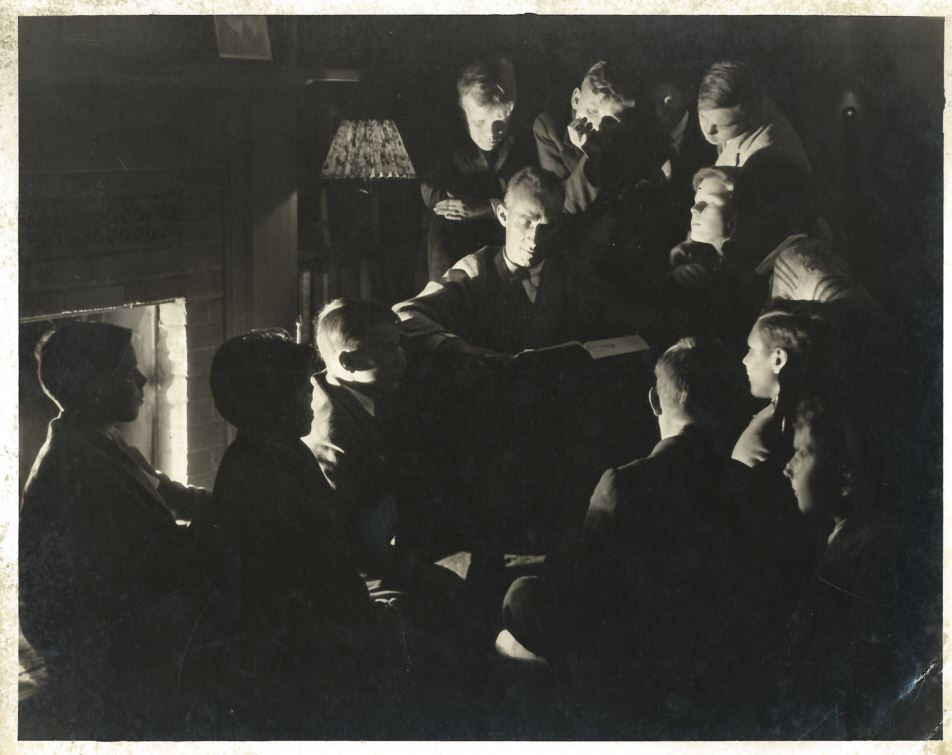
Here is the fifth installment of recollections from D. Bruce Lockerbie.
Dr. Frank E. Gaebelein had hired me in April 1957, after dinner at a steak house north of Wheaton, Illinois. But my wife Lory and I had never seen the campus until an early June day. We’d left our farm house apartment in the Midwestern cornfields to return East, planning to occupy a room in Lory’s mother’s Brooklyn home until The Stony Brook School could place us in our assigned housing. I was entered in major track meets in New York City and elsewhere, hoping (now as a naturalized citizen since January) to qualify for a European tour representing the USA.
We were eager to see our new location, so on a day appointed by FEG, we drove up Chapman Parkway and were immediately favorably impressed by the quiet beauty of the place—beautified by its arboretum of blossoming trees, quiet because we couldn’t find anyone to speak to. The campus seemed totally deserted. We later learned that everyone was at lunch in Johnston Hall. So, finding no one to give us information, I drove back down to the Carriage Museum intersection where we had noticed a sign pointing to the village of Stony Brook. Ah! Magnificent! After the bland, unhistoric sameness of the Midwest, Ward Melville’s hillside arc of shops in faux-Colonial architecture seemed to be just the right setting for our new home. And there was a charming inn and restaurant, beckoning us for lunch.
We seated ourselves, and a waitress dressed like Martha Washington or Dolly Madison presented the menu. Remember the economics of sixty years ago: I was a college instructor/coach and theology student; my wife was a part-time nurse, now very pregnant. I gave the menu a cursory glance and announced—to my wife’s chagrin—that we could not afford to remain as diners. We left as unobtrusively as possible and headed up the hill to the Stony Brook Apothecary, whose black letter signage also announced it as a luncheonette. There for one dollar total we feasted on two lettuce-and-tomato sandwiches (35 cents each), two Cokes (10 cents each), and left a dime tip.
We ventured back to the campus, by which time an ample number of young men in jackets and ties were visible. One of them directed us to the Headmaster’s Office in Memorial Hall. Frank Gaebelein greeted us both with warmth and, after taking note of Lory’s condition and politely asking when the baby was due, asked if she might be available and willing to have a conversation later than afternoon with the Business Manager, James Hill, regarding employment as nurse-in-residence during the coming Stony Brook Assembly season. This was an immediate answer to prayer because Lory’s appointment would provide us with summer-long accommodations on the campus and meals during the conference dates, as well as an opportunity to make contact with a local doctor and hospital.
We learned that we had arrived in the closing days of the school year. Classes had concluded, and final examinations were being held (mornings and afternoons) in Carson Auditorium. As soon as the afternoon session ended, the Director of Studies named Marvin W. Goldberg would meet with us; in the meantime, his wife Dorothie would show us the community called the Three Villages.
So, Dorothie Goldberg gave us the royal tour, then delivered me back to the flagpole in the quadrangle facing Carson Auditorium, while she took Lory to speak with Jim Hill in the Business Office, then to her home to meet some of the other faculty wives. Marvin Goldberg greeted me as a new colleague and told me that he’d seen me run on occasion; then he asked, “Do you by any chance have your running gear with you?” I did because I’d hoped not to miss the day’s workout in preparation for my coming competition. He took me to the Carson basement and its dungeon-like locker room, where I changed into shorts, jersey, and flat shoes—while carrying my spikes, just in case.
We walked to the 440-yard (approximately?) dirt oval that had served the School’s runners since it was first carved out of the sand and clay of Fitch Field. Its four-lane homestretch actually rose in an incline near the finish line, meaning that the backstretch was slightly downhill. But it had been good enough for Cary Wiesiger in 1927 and Bruce Dodd in 1949, so who was I to complain? I ran a couple laps at competitive half mile pace (52 seconds or so), after which Coach Goldberg asked if I’d like to see the nearby cross country course.
We rode down Hollow Road to a narrow gravel path that took us onto an expanse of property he identified as Forsythe Meadow. It appeared to consist of three adjoining fields. He drove through two of them and only pointed to the third, reachable through a narrow opening in a hedge and bringing into view a very steep climb back to the middle field and its finish line. Referring to a difficult ascent at Van Cortlandt Park in New York City, he asked, “Would you like to try our version of ‘Cemetery Hill’?” He stopped the car, and I obliged by running through the farther field and up the most challenging hill on the course.
We returned to campus and prepared for dinner in Johnston Hall dining room. Of course, we sat at the Goldbergs’ table with their daughters Louise and Nancy. It was a memorable meal, served by a member of the soon-to-be graduating class named Gordon MacDonald: A slice of ham accompanied by pineapple and a raisin sauce. After being introduced to a number of the other faculty members, Lory and I drove back to Brooklyn, sharing our first impressions of our new home.
Within two weeks, we returned to occupy the nurse’s quarters in the Infirmary (now the Health Center), where our belongings from Wheaton were delivered and stored until we knew where we’d be placed on campus. Lory’s duties during the eight weeks of the Stony Brook Assembly’s residential conferences were very light: She was available for a walk-in clinic each morning and generally on-call as needed. I ran well enough to qualify for the National Championship meet in Dayton, Ohio, and posted my best time to date in the 800 race; but Lory and I had decided that our move to Stony Brook required multiple adjustments—for instance, settling on a doctor to care for her and deliver the baby in October; moving from our temporary summer home to whichever residence hall apartment would be our permanent setting; not to mention my preparation to teach English classes (which grade levels yet to be determined) and conduct the choir called “The King’s Men,” whose former director had been a rather gifted soloist named Frank Boggs. So I agreed not to accept any opportunity to compete overseas. Instead, I found work in a summer day camp and regular tutoring assignments among children of the city-folk who were summering in Stony Brook.
By Labor Day, I’d read all the books on the School’s extensive summer reading list, and because I knew that “boys will be boys,” I’d also made it a point to check the TV schedule for late-night movie versions of those books and the differences between film and the printed page. But I still didn’t know my teaching assignment. Soon after Labor Day, FEG informed me that we’d be occupying the north apartment in Hegeman Hall, from which Don and Esther Marshall were moving to a house. We were delighted. Senior boys in the best of the three dormitory buildings.
Later that same week, as I was making my way between the Infirmary and the Hegeman apartment, a voice called out, “You Lockerbie?” I confirmed my identity to a cheery looking older man, who as he approached said, “Curtis here,” and (this being before the broad use of paperbound books) thrust two large and extremely heavy literature anthologies at me. I could see on the covers that they were intended for grades 9 and 10, which gave me a clue to my teaching assignment. But I needed more: “What do I do with these,” I asked—and received the wisdom of the ages: “Make boys love books.” And he walked away, leaving me with the best and briefest and only course in educational method I ever received.
Over the ensuing eleven years, until his retirement in 1968, Pierson Curtis (our beloved PC) taught me far more about the art of encouraging young men and women to appreciate, absorb, and become influenced by the power of great literature. It happened not by force or compulsion but by the immediacy and authenticity of the teacher’s passion for the sublime miracle of language to stir the imagination. He taught me the effectiveness of humor and self-deprecation, as when he described his own success as a runner (one mile and two miles) at Princeton. In his senior year (1913), he was entered in the Intercollegiate Championship meet at Cambridge, running against the one-time world record holder John Paul Jones of Cornell and the 1912 Olympic silver medalist at 1500 meters Norman Taber of Harvard (whose daughter was none other than Mary Simmons of revered memory). Jones beat Taber in a new world’s record time of 4:14.4, and PC recalled that he “had an excellent view of the race from the rear.”
Our Hegeman Hall apartment had three rooms, a living room and kitchen on the ground floor and an interior staircase from the kitchen leading to our bedroom and bathroom. By the time we settled in as residents, the early football and cross country athletes had arrived for a week of two-a-days in the September heat. One afternoon, as the players returned from the field where O. Floyd Johnson, his brother-in-law John Warren Hershey, and Don Marshall had been tormenting them, several of the weary youths in the second floor corridor outside our upstairs space expressed themselves loudly and profanely. I was outraged! I’d spent four years in the locker room at NYU, where I’d learned anything I didn’t already know about male vulgarity; but I’d been more recently at Wheaton College, where “frit” and “what the frit” were the epithets of choice. So my ears had become more tender than I realized. I bounded out into the corridor and accosted the first two malefactors I saw. They were astonished by my sudden appearance and aggressive reaction against the language I’d heard. After my lecture on acceptable and unacceptable speech, I returned through the door that had taken them by surprise, and I heard one of them ask, “Who the frit is that guy?”—or the Stony Brook equivalent thereof.
The next day, Lory and I began making ourselves visible in the dining hall, and I attended the afternoon cross country practice. I met the veterans—Tonnie Coane and Ray Searby—and a new kid from Philadelphia named Robin Lingle. During a lull in the workout, I told Marvin Goldberg about the incident the previous afternoon and expressed my disappointment—indeed, my dismay—at such language here at Stony Brook. He looked at me very sternly and said simply, “Bruce, that’s why Jesus died on the cross.”
As with PC’s brief instruction for teaching literature, so too MWG’s brief admonition to my foolish and unrealistic expectations of a teenager’s spiritual state. I needed that second lesson even more than the first. And I needed it daily for the next 34 years.

 stonybrookbears.org