Here is the third installment of recollections from D. Bruce Lockerbie. Read his first two here and here.
Six decades ago, the Stony Brook Assembly was in decline.
So what? For most readers of these nostalgic narratives, that foregoing sentence has little meaning or relevance to their connection with The Stony Brook School. They are unlikely to know much about the history and development of the organization that founded and owned The Stony Brook School for much of its first half-century. Some may have read The Way They Should Go (Oxford University Press, 1972), my account of those first fifty years; others have simply occupied the campus and received their education without any need to know who or why the names Carson, Chapman, Johnston, Fitch, Hegeman, Barnhouse, Kinney, Monro, Swanson, Alexander, Simons, Cleveland—or, for that matter, Gaebelein—appear around them.
I realize that this is essentially a sports page in the Brooker cyber-journal, but without the Stony Brook Assembly there would have been no school, no Bears, and no sports legends about which to write. So, without reiterating the full contents of the book—now itself 44 years old—here’s a brief summary of what Paul Harvey used to call “the rest of the story.”
In 1879 and 1881, the evangelist Dwight L. Moody founded the Northfield School for girls and Mount Hermon School for boys in his native village of Northfield, MA. Pierson Curtis was a 1909 graduate of Mount Hermon, and our Head of School, Joshua Crane, is an alumnus of the now combined Northfield Mount Hermon School. This was the period of the summer “camp meetings,” popularized by Methodists at Chautauqua, Oak Bluffs, Shelter Island, Ocean Grove, and elsewhere. Moody began a summer conference at Northfield, offering Bible teaching and Sunday School instruction away from the urban heat. But after Moody’s death in 1899, both his schools and the summer conference abandoned his strong evangelical theology. Pastors who had been sending their Sunday School teachers to Northfield agreed that they could no longer support the “modernist” teaching there and began looking for an alternative. Two locations were proposed, at Montrose, PA, and on Long Island, near the summer home of John Fleming Carson, pastor of Central Presbyterian Church in Brooklyn, and a major figure among Presbyterians.
In 1907, a group of Presbyterian pastors and laymen joined Dr. Carson in founding the Stony Brook Assembly and purchased the property that is now our campus. In 1909, they commenced operations in a tent pitched on the front lawn of Carson’s home on Christian Avenue—now the site of the Stony Brook Community Church and its parish house. The next summer, they occupied the largest meeting place on Long Island, the wooden tabernacle at the highest point of the rising ground from the Long Island railroad station—now Carson Auditorium—capable of seating more than 1,000 people with a choir loft for more than 100 singers.
Over the ensuing decades, thousands of people from across North America and overseas attended the gatherings of the Stony Brook Assembly to hear the great preachers of their era. Long before Ward Melville built the Village Center, long before Stony Brook University arrived in town, the words “Stony Brook” referred to the Assembly’s Bible conferences. As the Assembly flourished, its holdings expanded throughout the village, including ownership of what is now the Three Village Inn and the Sand Street Beach. Loyal annual attendees built or bought houses, a few of which are now faculty residences once occupied by families named Johnson, Hershey, Goldberg, Marshall, Stewart, and Lockerbie.
After the end of World War I, when the Assembly decided to found a boys’ school, the conferences were a strong recruiting tool for the school as parents returned home and considered enrolling their sons. But most of these conference-goers occupied rooms in what had become the school’s residence halls, including faculty apartments, which meant that teachers’ families were evicted in mid-June and their furniture and other belongings removed to storage, then brought back in late August.
By the late-1950s, two developments brought the Stony Brook Assembly’s conferences to a halt: First, competing Bible conference grounds began constructing more modern accommodations—making a communal bathroom-and- shower down the corridor in Johnston Hall much less appealing to summer guests; second, a faculty wife named Mariel Ward faced down Frank Gaebelein, informing him that she and her husband Robert Ward would not move from their dormitory apartment. FEG was wise enough to recognize a revolt brewing and urged the Assembly to reconsider its summer program—which ended soon thereafter.
What about those other names on campus? The profile on the School’s Wikipedia pages provides brief summaries of the named memorials that trace the history of both the Assembly and the School. Here are a few athletic connections:
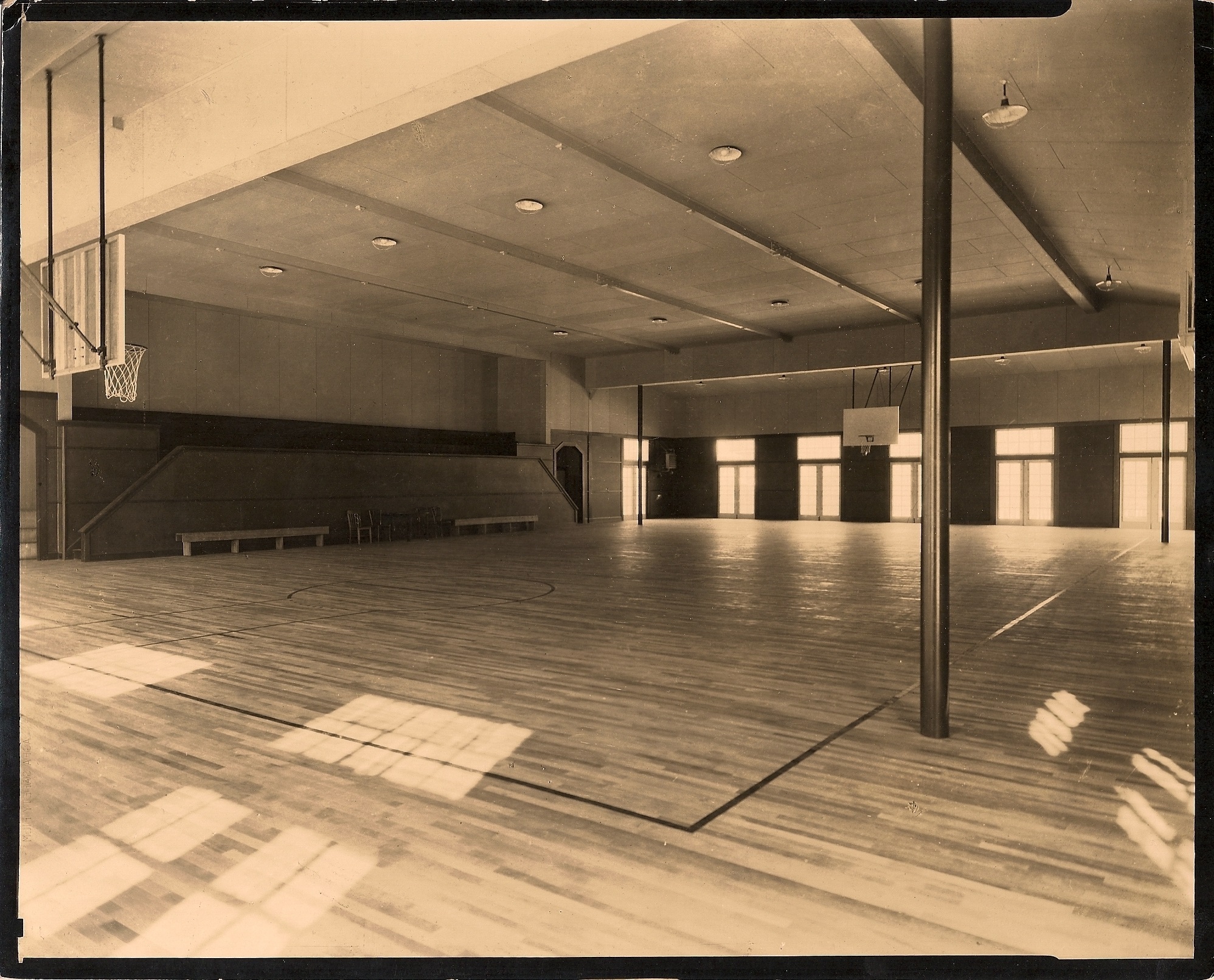
- Carson Auditorium served as the principal gymnasium until 1973. When the State University at Stony Brook first arrived in 1962, having no gymnasium of its own, the Seawolves’ basketball team—briefly coached by Rollie Massimino, later NCAA winning coach at Villanova—practiced in Carson.
- In 1922, when the School opened, the campus was still covered by trees, and the only playing field was the sloping land south of Memorial Hall. In 1925, Fitch Field, named for the family whose printing company developed the overnight stock market results, was cleared for the football team, coached by Clyde Mellinger. The original four-lane track surrounding the field was a combination of dirt and sand and rose uphill in the homestretch. The benefactor, John Knowles Fitch, was a board member and father of an early graduate, John K. Fitch, Jr., ’24. His son John K. Fitch III, ’60, now president of the Fitch Group, was a member of a Penn Relays team that trained on the track his family created.
- Aldon Kinney, ’39, funded the auxiliary gymnasium called Kinney Fieldhouse in 1959. Its original dirt surface was transformed for greater usefulness by the installation of an all-purpose sports floor.
- In 1973, the School acquired the great asset that is the gymnasium named for Robert S. Swanson, Sr., president of the S. B. Thomas Company, famous for its English muffins. He had been a board member and father of four alumni sons, Robert, Jr., also board chairman, David, Jack, and Dan, and grandfather of Alan, Robert, Larry, David, and Tom, also graduates and all of them athletes. Frank Gaebelein told me this story: Early in World War II, when food rationing was imposed and meat was scarce, Swanson’s sons must have complained to their father that the School’s main protein was beans served night after night. Their father decided their lament called for an in-person meeting with the Headmaster and arrived by train late one afternoon to make the case for his sons’ improved diet. As their meeting ended, Gaebelein suggested that Swanson remain for dinner and taste for himself whatever was being served. “As we entered Johnston Hall,” FEG recalled with impish delight, “wafting from the kitchen was the aroma of steak—the first time it had been available in weeks!”
During the tenure of Donn M. Gaebelein, ’45, as Headmaster, The Stony Brook School officially became independent of the disbanded Stony Brook Assembly. But all we know and cheer for in Stony Brook School Athletics began with the sponsorship and support of the Stony Brook Assembly and its summer Bible conferences.

 stonybrookbears.org