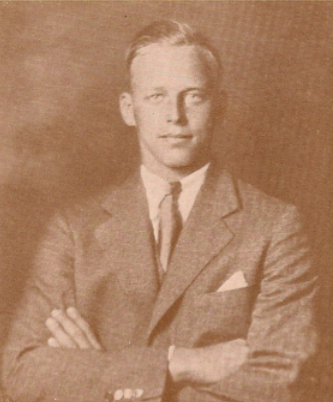
A great sportsman is a great gentleman and a real Christian. He fights for ideals and he gives life all he has, but he is always generous to his opponents, undisturbed by defeat, unsettled by the bad breaks of the game only if they give him an unfair advantage over his rivals. He takes things as the fates decide.A great sportsman is so modest that he is never conscious of his qualities. He is bewildered by praise, abashed by compliments. His leadership lies in his native qualities--the things which have come to him through his parents. He is always natural, always playing his hardest because he knows no other way. He never cuts corners; he never thinks of anything except the course he is asked to steer. He sails to victory because he must follow the chart of the Great Skipper.Arthur S. Draper, editor of the Literary Digest upon the death of Bruce
In the fall of 1929, Bruce Vanderveer entered the Stony Brook School as a junior after attending Riverside Military Academy in Georgia and Mercersburg Academy in Pennsylvania. While at Stony Brook he made a mark in a variety of ways as he starred at center on the football team, garnered Cum Laude honors, and was voted “Most Popular” by his classmates. Res Gestae 1931 had this to say about Vanderveer’s football prowess: “Bud was one of the best centers that Stony Brook has ever seen. He plays a hard, fast game, never letting up once. In the center position he proved to be a very tricky player in that he played both in and out of the line. On the offense he was a cool, steady passer and his loss will be greatly felt next year.”
Upon graduating, Bruce entered Harvard University in the fall of 1931 where he joined the crew team. Despite the fact that he had never pulled an oar, he was elected captain because of his exceptional leadership and determination. A true renaissance man, he was also a master seaman and in 1931 won the Junior Championship of Long Island Sound. A year later he piloted his way to the championship of the Western Long Island Sound Star Fleet which qualified him for a place in the prestigious International Series. On September 19, 1932 he and his Bandit II sailboat won the third race of the Internationals by an incredible eight minutes over the 27 other vessels. His victory was so dominant that the newspaper recounted, “It might well have been said there was no second.” The day after this glorious victory Bruce died in a tragic car accident.
Nobody can say what great victories Bud Vanderveer might have won, if he had lived to play the greater games of life. But nobody who knew him doubted that his life would be in maturity as it was in youth, one of high achievement and fine inspiration.

"To a Sportsman"
Bruce was an exceptional athlete and a brilliant scholar, possessing a personality that drew people to him, but the legacy he left is more than a collection of tackles, grades, and friends. He was the possessor of a sterling character, a true sportsman in victory and defeat, and one who left a deep impression on everyone he met. His lasting influence is aptly expressed in the eulogy given by Reverend William Grime on September 23, 1932:
The secret of his outward triumph lies here. He first of all attended to winning magnificent victories within the depths of his own soul... His heart was pure because he fed it from the springs of a simple and sound religious faith. As he passed from one seat of honor to another, his fearless yet gentle spirit remained true, reverent and fascinatingly modest... To measure the triumphs of his far flung penetrating influence is impossible. However, may I remind us that not only young men reverenced him, but full-grown men drew lasting inspiration from his rugged, sun-crowned soul.They recognized behind his happy eyes a deep, quiet, wise spirit plus a dogged determination that was ever alert for more worlds to conquer. They recognized in him an instinctive noble sportsman always void of bitterness in defeat. Defeat to him was simply a call upon his God-given powers for more skill and courage. Those of us who had the privilege of calling him friend, are now like people standing near the foot of some towering mountain. We cannot see it all. Neither can we see now, all that he has achieved.
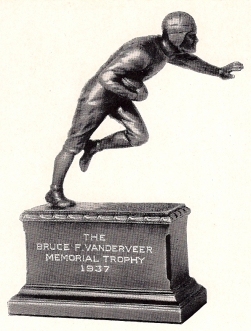
To this day Bruce is honored by two awards bearing his name. Each year at Stony Brook’s Class Night, the Bruce F. Vanderveer Memorial Trophy is awarded. From 1933-2015 it went to a member of the football team who showed the highest qualities of sportsmanship, but in 2018 the criteria was expanded to allow athletes from any team the ability to win the program’s highest award. Harvard University also awards a trophy in honor of Bruce to the outstanding member on the freshman crew team. Bruce Vanderveer was a man of integrity and honor, and though his life ended prematurely, his character was fully ripened and still stands as a measure of what each Stony Brook man and woman should strive for.

Bruce F. Vanderveer Memorial Trophy Recipients
| 1933 | Charles Bixler | 1934 | John Gilmartin |
| 1935 | Alfred Van Ranst | 1936 | John Krull |
| 1937 | Lionel Willett | 1938 | Harry Neber |
| 1939 | Robert Boehm | 1940 | Norman Wiedersum |
| 1941 | Edwin Ludwig | 1942 | Harold Presada |
| 1943 | Robert Wylie | 1944 | Caleb Sniffin |
| 1945 | Donald Walker | 1946 | John Buyers |
| 1947 | Lynn Osbourne | 1948 | Kendall Haf |
| 1949 | Kendall Haff | 1950 | Henry Evers |
| 1951 | Arnold Trygsland | 1952 | Peter Schmauss |
| 1953 | John Provan | 1954 | William Strong |
| 1955 | John Green | 1956 | William Peirce |
| 1957 | John Weber | 1958 | Alfred McKegg |
| 1959 | Richard Green | 1960 | Richard Duffy |
| 1961 | David Cloos | 1962 | John Clark |
| 1963 | Douglas Wedel | 1964 | Eugene Lyman |
| 1965 | Kent Picken | 1966 | Paul Cash |
| 1967 | James McRae & Jon Malkmes | ||
| 1969 | David Stevens | 1970 | Mark Cutbirth |
| 1971 | Ken Berg | 1972 | James Andrews |
| 1973 | Douglas Korber | 1974 | Scott Wruck |
| 1975 | Daniel McNeill | 1976 | Gordon Taylor |
| 1977 | Will Harrison | 1978 | Erik Fritjofson |
| 1979 | Peter Leftheris | 1980 | Charles Fields |
| 1981 | Louis Peraertz | 1982 | Tim Kennedy |
| 1983 | Peter Hensley | 1984 | Seth Cohen |
| 1985 | Jeff Newton | 1986 | Daniel Weiss |
| 1987 | Aaron Cooper | 1988 | Jordan Nixon |
| 1989 | Brian Stemple | 1990 | Cameron Thiessen |
| 1991 | Jonathan Schwartz | 1992 | Jeremy Linzee |
| 1993 | Nathan Carlson | 1994 | Jonas Fischer |
| 1995 | Matt Mattimore | 1996 | Joel Caldon |
| 1997 | Derek Kenney | 1998 | Ushinde Payne |
| 1999 | Anthony Passalacqua | 2000 | A. J. Talboo |
| 2001 | Ben Pinder | 2002 | Stephen De St. Aubin |
| 2003 | Jharod Lashley | 2004 | Ryan Mealey |
| 2005 | Cliff Seaman | 2006 | Chris Myrtil |
| 2007 | Terrance Anderson | 2008 | Tshepo Malete |
| 2009 | Tshepo Malete | 2010 | Lesedi Malete |
| 2011 | Wyatt Piazza | 2012 | Wyatt Piazza |
| 2013 | Marco Masakayan | 2014 | Tyler Hoegsberg |
| 2015 | Erik Holvik | 2018 | Jai Narain |
| 2019 | Riley Corcoran | 2021 | Jaden Lee |
He was too big to leave just a memory. There seems a part of him still here...

Bud was without a doubt one of the finest boys I've ever known.

A finer lad from every standpoint was never in my classroom.

He was a gentleman at all times, a perfect sportsman.

I have built around him, in my mind, an ideal or a model upon which I would wish a son of my own to be formed.

I never heard a word said against Bud. It would be superfluous to say more of him.

Bud was a prince among fellows, and I count his friendship as one of the greatest privileges of my life.

A finer man never went to his God.

~ Excerpts from letters sent to Bruce's parents after his death
 stonybrookbears.org